Showing posts with label japanese history. Show all posts

Ninjas

| |

Ninjas


-Ninja(shinobi in Japanese) was a covert agent or mercenary in feudal Japan capable of working in unorthodox methods and arts of war. They were masters of espionage, sabotage, infiltration, assassination, and also open combat situations.
-They used covert methods of waging war, they clashed basically with the samurai, who had strict rules about honor and combat, where as ninjas don't care.
-By the time of the Meiji Restoration(1868), the time of the shinobi had become a topic of popular culture, and mystery and imagination. Some of the abilities included walking on water, invisibility, control over the natural elements.
History
-Pronounced shinobi, meaning "to steal away"
-Also can apply to kunoichi(female ninja), which became more known in the post WWII world
-Ninjas made their debut in the 15th century, as spies, raiders, arsonists, and even terrorists
-Among the samurai, a sense of ritual was established.
-There was a ranking system for ninjas. Spy was called kancho, scout was called teisatsu, surprise attacker was called kishu, agitator was called konran. Jonin was referred to as upper man, with chunin as middle man and genin as lower man, who were the ones to carry out the dirty work


Roles

Espionage
-Chief role of the ninja
-With the help of disguises, the ninja could gather info on enemies, obtain passwords, and communiques.

Sabotage
-Arson was the primary form of sabotage practiced by ninjas. They often targeted camps and castles

Assassination
-Most well known cases of assassination involves famous historical figures.

Countermeasures
-There were various measures to prevent ninjas. Such as weapons in lavatory, or under moveable floorboard, buildings made with traps and trip wires attached to alarm bells
-Japanese castles were made to be hard to navigate, with winding routes to the inner compound. Blind spots and holes in walls provided constant surveillance of these labyrinth paths. Such examples are seen in Himeji Castle, Nijo Castle in Kyoto. They are made with "nightingale floors", which rested on metal hinges specifically designed to squeak loudly if walked over. Grounds with gravel over it also gave early notice of intruders

Tactics

Hitsuke: practice of distracting guards by starting fire  away from ninja's planned point of entry
Tanuki-gakure: practice of climbing a tree and camouflaging themselves
Ukigusa-gakure: practice of throwing duckweed over water to conceal underwater movement
Uzura-gakure: practice of curling into a ball to remain motionless to look like a rock

Disguises
-Could disguise themselves as anything, such as fortune tellers, priests, entertainers, merchants, monks

Clothing
-Black was a common color to show invisibility
-Similar to the samurai, but loose clothing
-Lightweight armor for protection


Tools
-Ropes and grappling hooks for climbing
-Chisels, drills, picks, hammers
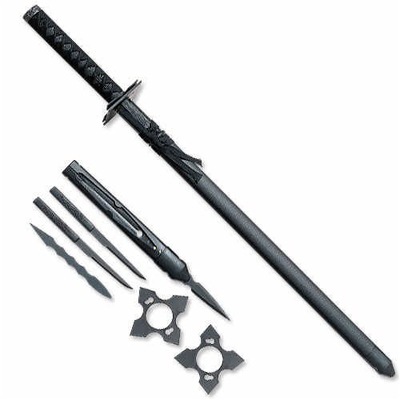
-Kunai(Japanese masonry trowel, which it looks like)
Weapons
-Katana(aka Samurai sword)
-Darts, spikes, knives, shuriken(throwing stars)
-Bows and arrows
-Kusarigama(chain and sickle)
-Soft cased bombs with shrapnel, glass, poison gas, smoke inside

Readmore..

Samurai

| |

Samurai

-Term for nobility of pre-industrial Japan.
-They followed a set of rules that came to be known as bushido.
-While they made up less than 10% of Japan's population, samurai teachings can be found today in both everyday life and in modern Japanese martial arts

History
-In the early Heian period, basically the late 8th and 9th centuries, Emperor Kammu decided to expand his rule in northern Honshu. He introduced the title of Seiitaishgoun or shogun, and began to rely on these powerful soldiers to remove any of the Emishi people.
-These soliders, skilled in mounted combat and archery(kyudo), these warriors became the emperor's preferred tool for removing rebellious people.
-The title of shogun was not used until the 13th century.
-These clans formed alliances to protect themselves from other clans, and by the time of the Heian period, they adopted characteristic Japanese armor and weapons, and that is how they laid the foundation for Bushido, their code of honor
-In the 14th century, a blacksmith named Masamune created a two-layer material for soft and hard steel for swords. This gave the item a much more improved cutting power and endurance. This led to the creation of Japanese swords(katana) being used.

Culture
-Samurai developed their own cultures that influenced Japanese culture as well. This culture associated with the samurai included tea ceremony, monochrome ink painting, rock gardens, and poetry. These were adapted from the Chinese arts. Zen monks introduced them to Japan and they were allowed to decline due to interest of powerful warriors.

Education
-In general, samurai warriors were aristocrats, and priests who had a very high literacy rate in Kanji.


Names
-How samurai got their names is they combined one kanji from his father or grandfather, and one new kanji.

Marriage
-How samurai got married is it was arranged by someone with the same or higher rank
-Marriage was a necessity for those in upper ranks, and for lower ranked samurai, it was a formality.
-Most of them married a woman from a samurai family, but for lower ranking members, marriage to commoners was okay.
-If a samurai wanted a mistress, her background was given a very strong looking over by a higher ranked samurai.
-A samurai could divorce his wife for various reasons, with approval from a superior, but it was nonexistent. A reason for divorce could be that the wife could not produce a valuable son, but the adoption was the answer for divorce. And even if he simply did not like his wife, he could divorce her. If the wife were cast off because of dishonor, she could commit jigai(a female's seppuku)


Weapons
Japanese swords
-I.e. Katana(long sword), wakizashi(side inserted sword)
The Yumi(longbow)
-Major weapon of the Japanese military
-Made from bamboo, wood, rattan, leather
-Had a range of 50 meters

Pole weapons
-Yari(spear)

Staff weapons
-Bo(bamboo staff)

Chain weapons
Kusarigama(chain sickle)


Armor
-Early armor made from leather or iron
-Later armor was made from iron
-Had a helmet, called a kabuto, to protect the samurai's face from weapons


Pop Culture
-There have been films made over the years to feature these warriors.
-The Seven Samurai(Akira Kurosawa) was made in the 1950s and is entirely in Japanese language with English subtitles. This one rocks!!


-In Japanese comics(manga) or animation(anime), the Samurai are very popular topics. They mostly feature a good guy who is a samurai or a former samurai who possesses martial arts skills. Even American comic books have adapted the Samurai into their comics.

Readmore..

Konnichiwa, Japan!

| |

Art


Masks


Clothing


Readmore..

Calm, Serene, Zen Gardens

| |

If I had my own place, with a backyard, it would look something like this or I would like something like this:


Readmore..
Related Posts Plugin for WordPress, Blogger...
 
© Copyright 2010. yourblogname.com . All rights reserved | yourblogname.com is proudly powered by Blogger.com | Template by FREE IMAGES - zoomtemplate.com